Climate controls are convenience settings, but some of them directly affect what you can see through the windows. This page explains the common symbols and how automatic and manual systems differ. Your manual describes exactly how your system links these functions together.
- System
- Heating, ventilation and air conditioning
- Purpose
- Comfort and window visibility
- Manual check
- Climate control chapter
Temperature and fan
Temperature is set with a dial, rocker or on-screen slider, shown in degrees or as a red-to-cool scale. Dual-zone and multi-zone systems let the driver and passengers choose separately; a SYNC or DUAL button links or unlinks the zones. Fan speed uses a fan-blade symbol with steps or a bar graph. On automatic systems, adjusting the fan manually often takes that function out of AUTO until you press AUTO again.
Air distribution and recirculation
Seated-figure symbols with arrows show where air goes: towards the face, the feet, both, or the windscreen. Recirculation, shown as a car outline with a curved arrow inside, reuses cabin air. It can help cool the cabin quickly or reduce outside odours, but extended use tends to raise humidity and can fog the glass. Many systems cancel recirculation automatically after a while or when you select windscreen demisting.
Fresh air versus recirculation in practice
Some cars include air-quality sensors that switch to recirculation when they detect pollution, then back again. Others leave the choice entirely to you. Check whether your car has an automatic air-quality mode and how it shows on the display.
Demisting and defrosting
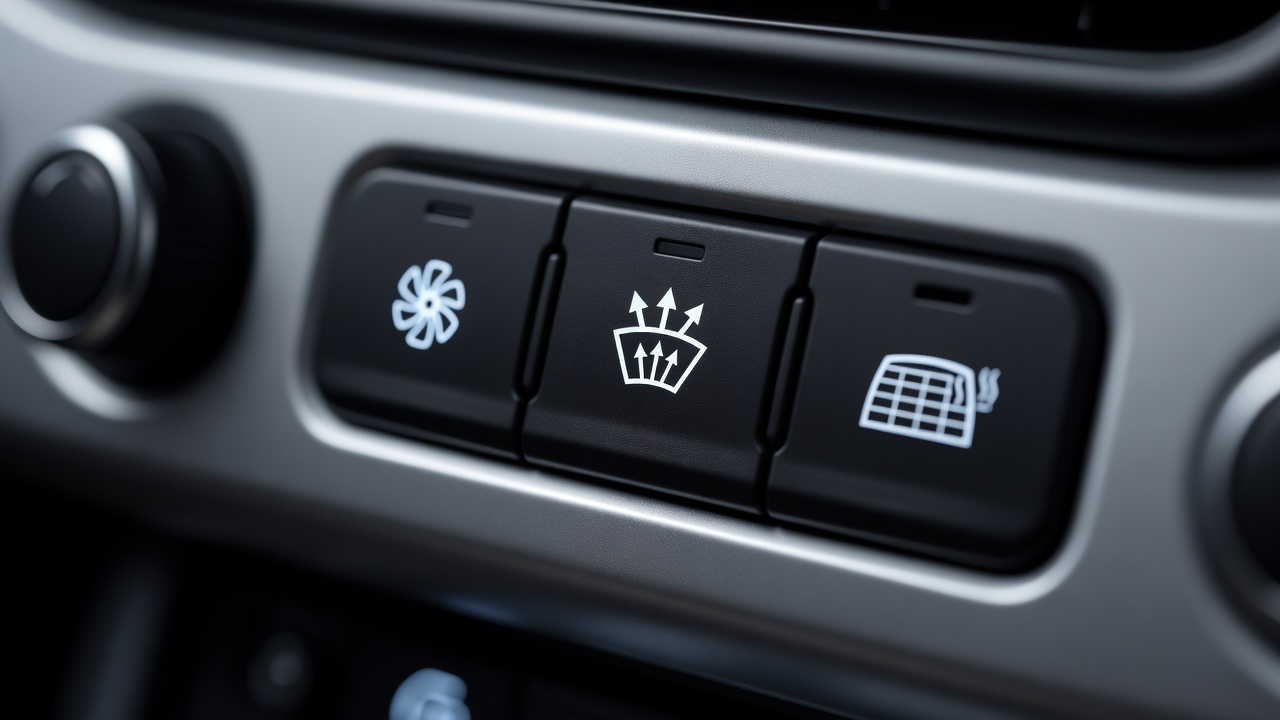
The front demist button usually shows a curved windscreen with wavy upward arrows. Pressing it typically directs air to the screen, raises fan speed and, on many cars, engages the A/C compressor because cooled air removes moisture before it is reheated. A rectangle with wavy arrows indicates the heated rear window, which often switches off on a timer and may also heat the door mirrors. Some vehicles have a heated front windscreen with fine wires and its own symbol.
Clearing the windows is a visibility task first and a comfort task second. If glass fogs while driving, use the demist function your manual describes and pull over if you cannot see clearly.
A/C and AUTO
The A/C button, often marked with a snowflake, switches the compressor on or off. It is useful for dehumidifying in cool, damp weather, not only for cooling in summer. AUTO lets the system manage fan, vents and compressor to reach your set temperature. Some cars offer an ECO or MAX setting that changes how aggressively the system works.
| Symbol | Function | Check in your manual |
|---|---|---|
| Snowflake / A/C | Compressor on or off | Whether demist engages it automatically |
| AUTO | Automatic regulation | Which manual changes cancel AUTO |
| Curved arrow in car | Recirculation | Automatic timeout or air-quality mode |
| Seat with wavy lines | Heated seat | Number of heat levels and timers |
| Seat with fan or arrows | Ventilated seat | Availability by trim |
Heated seats, EVs and preconditioning
Heated seats and heated steering wheels warm you directly and are often more energy-efficient than heating the whole cabin, which matters in electric vehicles. Many EVs and plug-in hybrids use a heat pump and offer preconditioning: heating or cooling the cabin, and sometimes the battery, while connected to a charger, often scheduled through the car's menu or a manufacturer app.
Physical buttons and touchscreens
Recent designs move some climate functions into touchscreen menus. If you cannot find a function, look for a climate shortcut bar on the screen, a voice command, or a hard key below the display. Front demisting usually remains a physical button on most models because of its visibility role, but this is not universal.
Where a general guide stops
Unusual smells, persistent fogging, water in the footwell or no warm air can point to faults that need inspection. We cannot identify these remotely; consult your manual and a qualified technician.