A tell-tale is a lamp in the instrument cluster that reports a condition: a system switched on, a fluid level, or a fault. This page helps you recognise common symbols and understand what owner's manuals typically ask. It does not diagnose your vehicle.
- System
- Instrument cluster and driver display
- Purpose
- Report status, caution or fault
- Manual check
- Warning and indicator lights chapter
How tell-tales are standardised
Many symbols you see are drawn from ISO 2575, the international standard for symbols on road-vehicle controls, indicators and tell-tales. In markets that apply UNECE rules, UN Regulation No. 121 sets requirements for identifying controls, tell-tales and indicators. In the United States, FMVSS 101 covers controls and displays. These rules explain why an oil-can or a seat-belt figure looks broadly similar across brands.
Standards do not cover everything. Manufacturers add icons for features they develop, combine several faults behind one symbol, or show a text message alongside the lamp. A symbol that looks familiar may therefore carry a slightly different scope on your vehicle.
Colour is a clue, not the whole message
A widely used convention groups tell-tales by colour: red for a serious condition or immediate attention, amber or yellow for caution or a fault to check soon, and green or blue for a system that is simply active, such as headlights or high beam. Treat this as orientation only. Your manual's instruction for the specific symbol always comes first, and some drivers cannot reliably tell red from green, which is why the shape and any message text matter.
If a manual tells you to stop, stop when it is safe to do so. If it tells you to contact a dealer or workshop, a general web page is not a substitute.
Common tell-tales and what manuals usually ask
| Typical symbol | Usual system | Typical manual direction |
|---|---|---|
| Oil can with drip | Engine oil pressure | Often: stop safely and switch off; check level as directed |
| Thermometer in waves | Coolant temperature | Often: stop safely and let the engine cool before any check |
| Battery outline | Charging system (12-volt) | Often: avoid unnecessary electrical loads and seek a check |
| Circle with exclamation mark | Brake system or parking brake | Confirm the parking brake is released; if lit while driving, follow brake warning advice |
| ABS in a circle | Anti-lock braking | Normal braking may remain, without anti-lock function; seek a check |
| Seated figure with circle | Airbag / supplemental restraint system | Restraint system may not deploy as intended; arrange inspection |
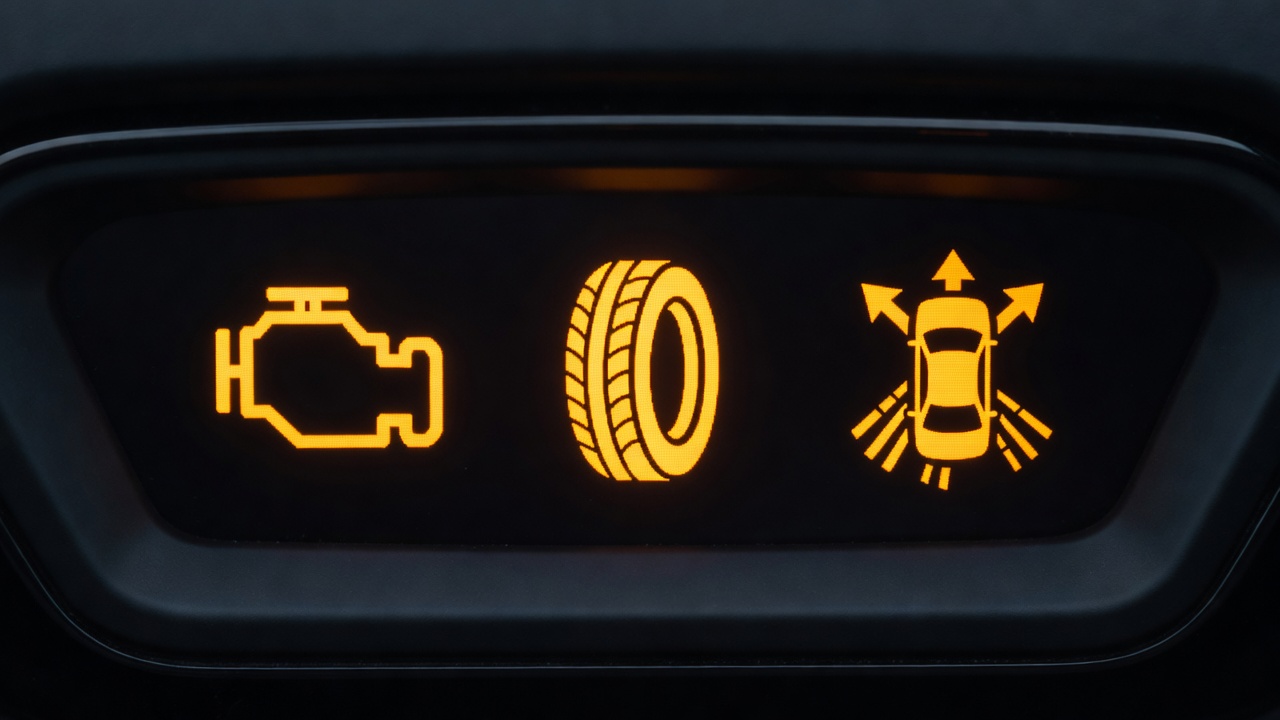
| Engine outline | Malfunction indicator lamp | Steady: arrange a check. Many manuals treat flashing as more urgent |
| Tyre cross-section with exclamation mark | Tyre pressure monitoring | Check pressures against the door-pillar placard or manual |
| Car with skid lines | Stability / traction control | Flashing usually means the system is intervening; steady may mean a fault or OFF |
The malfunction indicator lamp is tied to on-board diagnostics, known as OBD-II in the United States and EOBD in Europe. A workshop can read stored codes, but a code is a starting point for diagnosis, not a final answer. Tyre pressure monitoring in the US is required under FMVSS 138, and electronic stability control under FMVSS 126; equivalent requirements apply in other regions.
Electrified and diesel-specific indicators
Electric and hybrid vehicles
You may see a READY indicator showing the car can move silently, a plug symbol for charging status, a reduced-power or tortoise symbol, and warnings for the high-voltage system. Terminology varies widely between makers, so the manual is essential here.
Diesel vehicles
A coil-shaped glow-plug lamp often shows preheating before starting. Diesel particulate filter and AdBlue (diesel exhaust fluid) indicators relate to emissions systems; manuals describe regeneration driving or refilling procedures specific to the model.
Service and reminder symbols
Spanner icons, service-due messages and washer-fluid lamps are reminders rather than faults. They still deserve attention, but on a schedule set by the manufacturer's service plan.
Where a general guide stops
We cannot see your dashboard, know your vehicle's history or read its fault memory. If a warning appears, note the symbol, colour, whether it is steady or flashing, and any message. Check the manual, follow its instructions, and contact your dealer, a qualified technician or roadside assistance as appropriate. If you feel unsafe, prioritise getting the vehicle and its occupants out of danger.